Summary
On October 20, Peter Kennedy of the Futures Strategy Group asked whether we need more extreme scenarios today. A few days earlier, Harvard Kennedy School’s Belfer Center had published a pre-mortem of a major AI-enabled catastrophe. Both methods start from a future nobody wants to plan for. My thesis is that in projects and strategy work we plan too close to the present, and that these two methods are a good antidote.
Why Now?
Kennedy describes a feeling many of us share. Reality seems to be overtaking even the most radical scenarios. Covid-19, political division, and now AI. The natural reaction is to hunker down, put off big decisions, and wait for things to settle.
His answer is clear. Things never really settle. In strategic planning, he calls prediction “a losing endeavor”. Beyond the very near term, the only prudent way to plan is to assume the future will be fundamentally different and will challenge your own operating model.
Almost at the same time, the Belfer Center took a different route. Instead of sketching many futures, the authors assumed a single, very dramatic one and asked backward how it could have happened.
Two methods, one common core. What’s behind them, and what can we as project and program managers take away?
What Is an Extreme Scenario?
By its own account, the Futures Strategy Group has worked with “alternative futures” for a quarter of a century. These aren’t probability calculations or single events. They’re fully developed stories about fundamentally different environments. They should be relevant and accessible, but also provocative.
Three rules from the piece strike me as especially useful for our work.
- The scenario horizon lies well beyond the planning horizon. If an organization plans zero to five years ahead, FSG sets the scenarios ten years out or more.
- Scenarios must be plausible and internally consistent. As a check, FSG sketches chronologies of invented events leading from today to the scenario.
- Scenarios challenge not only assumptions about the future but also whether your own operating model still holds up.
According to Kennedy, the longer horizon frees people from the “tyranny of the present”. If you’re not tied to the timeline of current plans, you’re more willing to accept a truly different world.
An example from the piece shows how extreme this can get. In 2003, FSG wrote a scenario for the US Coast Guard in which a coronavirus originating in China kills ten million people worldwide. Covid-19 was still 16 years away. FSG itself stresses that prediction is never the goal. The value lies elsewhere. Kennedy argues that rehearsing several futures also prepares people for disruptions that never appeared in any scenario.
And now the real question of the piece. Do we need to deliberately stretch the boundaries of plausibility today to keep up with the pace of change? Kennedy sees a potentially big payoff. Broader and more resilient strategies, more agility, and a workforce that leans into the future.
Wild Cards and Stress Tests?
The discussion below the article, in which Kennedy himself takes part, is worth reading. Two suggestions from it are very practical.
Rodolfo Sabonge proposes keeping the core scenarios within a reasonable range and then stress-testing them with injected extreme shocks, much like central banks run their stress tests. Add clear early-warning indicators. And include extreme upside scenarios, not just threats. Extreme can also mean speed, when changes we expected over fifteen years arrive in two or three.
Charles Thomas writes that they occasionally do this already. The same extreme event is injected into all scenarios as a “wild card.” A powerful tool, he says, but tricky to get right.
My takeaway? Extreme doesn’t mean science fiction. Extreme means it hits our most cherished assumptions.
What Is a Pre-Mortem?
The idea comes from Gary Klein, who described it in Harvard Business Review in 2007. The team assumes the project it’s planning has already failed and comes up with plausible reasons why. The trick is psychological. People with doubts can voice them without being cast as naysayers.
The Belfer Center has now applied this method to a very serious subject. The October 15, 2026 paper by Stephen Casper and colleagues assumes that the first major AI-enabled terrorist event has already happened. “Major” is defined up front. At least 50 people killed or seriously injured, or at least one billion dollars in damage, based on thresholds in US laws on frontier AI.
From there, the authors work backward through the life cycle of an AI model. Five points where things can go wrong.
- How the dangerous capability is developed.
- How the model is deployed.
- How the capability is elicited.
- How safeguards fail.
- How detection fails.
At each point they ask which decision enabled the event and where it could have been interrupted. Their conclusion in short. Whether it comes to that depends largely on choices developers, distribution platforms, and governments are making today. The paper ends with nine falsifiable predictions and two explicitly hypothetical scenarios.
Speaking to the Harvard Gazette, Stephen Casper says they deliberately picked one of the more dramatic scenarios. The aim is to help prevent it or, if it does happen, to enable a faster and better-informed discussion afterward.
What interests me here is less the AI risk itself, important as it is. It’s the method. The threshold is defined in advance. The path backward is structured by phase. And the predictions are worded so they can be checked later.
What Can We Learn for Projects?
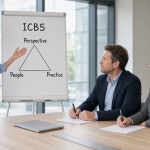
Quite a lot, in my opinion. We usually plan projects for their duration. Yet the benefits are often supposed to last many years beyond that. With its Momentum Model, ICB5 describes exactly this shift from “project delivered” to “value created.” I wrote about it in my post on the future of PM certification.
Applied to project and strategy work, I see seven starting points.
- Choose a scenario horizon longer than the project itself. The question isn’t whether the project finishes on time, but whether its result still holds up in ten years.
- Run a pre-mortem before kick-off or before a major steering committee decision. The project has failed. Why?
- Structure the path backward by phase, as the Belfer Center does, and ask for each phase where you could have stepped in.
- Define up front what “failure” means. Without a threshold, everyone ends up discussing a different problem.
- Inject one wild card into every plan variant instead of writing a separate disaster scenario.
- Define early-warning indicators for each scenario and track them in the status report.
- Play through the extremely good scenario, too. Sudden success can overwhelm a project just as much.
I have only used pre-mortems indirectly so far. In a current software development project, I will use exactly this approach for strategically supported AI discussions.
If you know reverse brainstorming, often called the headstand method in German-speaking countries, much of this will look familiar. Both flip the question toward failure. The difference lies in tense, purpose, and output.
- Reverse brainstorming asks, “How do we make this project fail?” It’s a creativity technique. The negative ideas are flipped back around and turned into solution ideas.
- The pre-mortem says, “The project has failed. Why?” The failure has already happened and is explained backward. It’s a risk technique. The result is a set of risks, warning signs, and points where you can step in.
An everyday picture. Reverse brainstorming asks how we could thoroughly ruin a dinner party, and derives from that what really matters. The pre-mortem imagines the guests have already left disappointed and asks what went wrong.
One point matters most to me. Both methods depend on dissent being welcome. In the discussion, Kennedy adds that extreme scenarios also weaken the influence of those who have seen it all. And then: “There are no experts on the future.” That’s a leadership task, not a question of method.
Where Are the Limits?
Of course, these methods aren’t a cure-all either.
- Scenarios are not forecasts. Selling the coronavirus example as a hit misses the point. FSG says so itself.
- Extreme scenarios can paralyze. Kennedy describes clients who already feel immobilized by constant disruption. If an organization’s hair is on fire right now, he says he actually advises against scenario work.
- Extreme has to be tailored, as Charles Thomas stresses in the discussion. A scenario that doesn’t affect anyone in the room remains a thought experiment.
- A pre-mortem is only as good as the willingness to hear uncomfortable answers. Without psychological safety, it ends up as a list of the usual suspects.
What Does This Mean for the Coming Years?
From here on, this is my assessment, not an established development.
If AI agents become team members, as I described in Project Manager in 2036, and prepare more and more of the planning work, our contribution shifts. Away from building the plan, toward questioning its assumptions. Scenarios and pre-mortems are made for exactly that.
The Belfer paper also shows that risks arise in chains of decisions. Who makes which decision, and where it can be interrupted, is a governance question. It belongs in steering committees, not just in risk registers.
And the point about speed from the FSG discussion stays with me. Maybe the extreme thing about the future isn’t the event itself, but that it arrives sooner than expected.
Kennedy closes with Louis Pasteur. Chance favors the prepared mind.
Which scenario would you never put in front of your steering committee? And why that one?
Feel free to subscribe to my free newsletter.
Sources
- Peter Kennedy: Do we need more extreme scenarios today? Futures Strategy Group, October 20, 2026 (incl. reader discussion, October 21–23, 2026) – https://www.futuresstrategygroup.com/extreme-scenarios/
- Max Kamachee, Jordi Weinstock, Antonia Juelich, Jonas Raedler, Elise Racine, Stephen Casper: A Pre-mortem on The First Major AI-Enabled Terrorism Event and The Choices That Could Enable It: Plus 9 Predictions. Belfer Center for Science and International Affairs, Harvard Kennedy School, October 15, 2026 – https://www.belfercenter.org/research-analysis/pre-mortem-first-major-ai-enabled-terrorism-event-and-choices-could-enable-it
- Christina Pazzanese: Is it already too late to reduce catastrophic AI risk? Harvard Gazette, October 19, 2026 – https://news.harvard.edu/gazette/story/2026/10/is-it-already-too-late-to-reduce-catastrophic-ai-risk/
- Gary Klein: Performing a Project Premortem. Harvard Business Review, September 2007 – https://hbr.org/2007/09/performing-a-project-premortem