Summary
A door swinging back against your hand is a small thing. Whether this kind of inconsiderate behavior is really on the rise is disputed among researchers. What it does, however, is well documented. It spreads, drains concentration, and slows the flow of information in teams. My thesis is that it is already seeping into our working lives, and for projects that is a real problem.
What Happened?
Saturday, October 24, in a store in Mainz, Germany. A clothing store. Nobody held the door, nobody looked back. The door swung back against my hand. I was frustrated. And I was worried about the future.
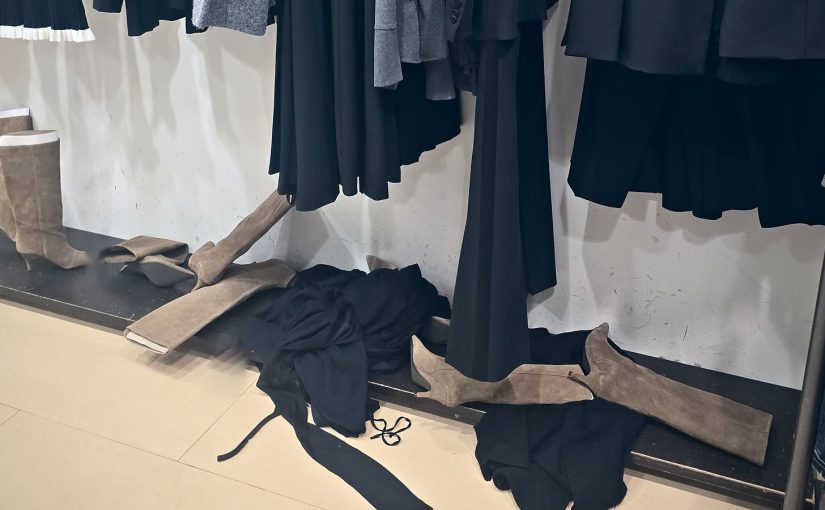
Inside, the place looked like a junk room. Several customers pushed neatly stacked clothes aside, piece by piece, to look for their size. The featured image is my own photo and shows what it looked like.
I see similar things on the street. My thesis is that this growing lack of consideration for others is already spilling over into our working lives. I think that is a big problem. So I looked at what research has to say about it.
Is It Really Getting Worse?
Many people share the feeling. In a survey by the Pew Research Center (2025, about 9,600 U.S. adults), 47 percent said people have become ruder in public since the pandemic. 44 percent saw no difference.
The workplace looks similar. In 2013, Christine Porath and Christine Pearson reported in Harvard Business Review that in 1998 a quarter of respondents were treated rudely at least once a week. By 2011, it was half. These are self-reports, though, not a representative time series.
And then there is the counterevidence. In 2023, Adam Mastroianni and Daniel Gilbert analyzed surveys with more than 12 million respondents in Nature. People in at least 60 countries have believed for at least 70 years that morality is declining. But when you ask about concrete behavior, such as whether someone was treated with respect the day before, hardly anything has changed over the decades. Their explanation is that negative things catch our attention more and that we forget past negatives faster.
So what does that mean for my observation? It is real. Whether it reflects a trend is an open question. What is certain is the damage inconsiderate behavior does where it happens.
What Does Rudeness Do to Us?
Here the research is remarkably clear.
Rudeness is contagious. In three studies in 2016, Trevor Foulk, Andrew Woolum, and Amir Erez showed that a single episode is enough. People who experience it become more likely to be rude themselves afterward. Even toward people who had nothing to do with it.
It colors the whole day. In 2017, Woolum and colleagues followed 81 professionals and managers over ten workdays. Those who merely witnessed rudeness in the morning perceived more of it throughout the day, made less progress on their tasks, and were more likely to withdraw from interactions.
Even watching has a cost. In experiments published in 2009, Porath and Erez showed that people who merely witness someone being treated with contempt perform worse on tasks, are less creative, and help less.
And it costs the organization. In Porath and Pearson’s 2013 survey of 800 employees, 48 percent said they had intentionally decreased their work effort. 80 percent lost work time worrying about the incident. 25 percent took their frustration out on customers.
For me, this is the bridge to my thesis. What is documented is that a single experience lingers for hours and gets passed on. What is not documented is that a ruder public sphere permanently changes work culture. That remains my observation. But whoever has a door swing back against their hand in the morning is sitting in the daily stand-up an hour later.
Why Do We Become Inconsiderate?
Usually not out of malice. I find three explanations plausible.
Hurry. In 1973, John Darley and Daniel Batson sent seminary students to give a talk, some of them on the parable of the Good Samaritan. On the way, a man lay slumped helplessly on the ground. Without time pressure, 63 percent helped. Under high time pressure, only 10 percent did. The topic of the talk made no difference. The study is old and small (40 participants). Still, everyone knows the pattern.
Overload. In Porath’s surveys, half of those who had been rude themselves said they felt overloaded. Only 4 percent said it was fun (Georgetown University, 2018).
Disorder as the norm. In 2008, Kees Keizer and colleagues showed in Science, with field experiments in Groningen, that visible rule-breaking leads to more of it. In front of a clean wall, 33 percent simply dropped a flyer. In front of a wall covered in graffiti, 69 percent did. Nobody has studied stacks of clothes. Still, the analogy to the store is obvious. Where it already looks like a junk room, the next person pushes things aside too.
What Does This Mean for Projects?
Projects live on information that people share voluntarily. A risk someone raises early. A question someone dares to ask. A mistake that gets reported before it becomes expensive.
That is exactly what suffers. In 2015, Arieh Riskin and colleagues had 24 neonatal intensive care teams work through an emergency simulation. A supposed outside expert made a few mildly disparaging remarks in passing that had nothing to do with the teams’ performance. Diagnosis and treatment got worse. Rudeness alone explained nearly 12 percent of the variance in performance. The reason was that the teams shared less information and asked for help less often.
Amy Edmondson calls what gets lost there psychological safety. In her 1999 study of 51 teams, the shared belief that the team is safe for interpersonal risk-taking fostered learning. And learning, in turn, drove performance.
IPMA’s ICB4 also describes this attitude as a competence. Under the competence element “Relationships and engagement,” it lists, for example, “Demonstrate empathy through listening, understanding and support” and “Show confidence and respect by encouraging others to share their opinions or concerns.” For us, consideration is therefore part of project competence.
In my opinion, the project manager plays the role of the store owner here. They shape what counts as normal in the team. Through what they do, and through what they let slide.
What Helps?
The good news is that mindfulness can be practiced. Paul Condon and colleagues (2013) showed this in an experiment. After eight weeks of meditation training, half of the participants gave up their seat to a woman on crutches, compared with only 15 percent in the comparison group. And that was even though two other people in the waiting room ignored her.
It is not a miracle cure. A meta-analysis by Vonderlin and colleagues (2020, 56 randomized trials) shows that workplace mindfulness programs reduce stress and improve well-being. There is no robust evidence for higher productivity. The authors also warn against using mindfulness to pacify dissatisfied employees. Handing out a mindfulness app while leaving the overload in place gains little.
For everyday project work, I mainly see small things.
- Plan buffers. People who are always in a hurry overlook others.
- Start meetings on time and end them on time. A clear agenda helps.
- Listen in meetings instead of reading email on the side. I wrote about how hard that is in my post on the 4-ears model.
- Address rudeness calmly and promptly. Staying silent turns it into the norm.
- Keep shared artifacts tidy. Backlog, file storage, minutes. Visible disorder invites more.
- Look back briefly at handovers. Who works with my result after me?
- In the retrospective, also ask how we treated each other.
- Small gestures. Say thank you, call back, know people’s names.
And Going Forward?
From here on, this is my assessment. Project work is becoming more hybrid and more tightly scheduled. Chance encounters are becoming rarer, messages squeezed between two meetings more frequent. Consideration therefore becomes less of a habit and has to be cultivated more deliberately. Whether inconsiderate behavior is really growing in society, research will tell. For our own teams, we don’t have to wait.
Holding a door costs two seconds. What it costs not to hold it is shown in the studies above.
Where does the junk room start in your project? And who will be the first to tidy up?
Feel free to subscribe to my free newsletter.
Sources
- Pew Research Center: Almost half of Americans say people have gotten ruder since the COVID-19 pandemic, March 12, 2025 – https://www.pewresearch.org/short-reads/2025/03/12/almost-half-of-americans-say-people-have-gotten-ruder-since-the-covid-19-pandemic/
- Porath, C. & Pearson, C.: The Price of Incivility. Harvard Business Review, Jan./Feb. 2013 – https://hbr.org/2013/01/the-price-of-incivility
- Mastroianni, A. M. & Gilbert, D. T.: The illusion of moral decline. Nature 618, 2023 – https://www.nature.com/articles/s41586-023-06137-x
- Foulk, T., Woolum, A. & Erez, A.: Catching rudeness is like catching a cold. Journal of Applied Psychology 101(1), 2016 – https://pubmed.ncbi.nlm.nih.gov/26121091/
- Woolum, A., Foulk, T., Lanaj, K. & Erez, A.: Rude color glasses. Journal of Applied Psychology 102(12), 2017 – https://doi.org/10.1037/apl0000247
- Porath, C. & Erez, A.: Overlooked but not untouched. Organizational Behavior and Human Decision Processes 109(1), 2009 – https://www.sciencedirect.com/science/article/pii/S0749597809000041
- Darley, J. M. & Batson, C. D.: From Jerusalem to Jericho. Journal of Personality and Social Psychology 27(1), 1973 – https://doi.org/10.1037/h0034449
- Georgetown University McDonough School of Business: Civil Actions, November 27, 2018 – https://msb.georgetown.edu/news-story/civil-actions/
- Keizer, K., Lindenberg, S. & Steg, L.: The spreading of disorder. Science 322, 2008 – https://doi.org/10.1126/science.1161405
- Riskin, A. et al.: The impact of rudeness on medical team performance. Pediatrics 136(3), 2015 – https://pubmed.ncbi.nlm.nih.gov/26260718/
- Edmondson, A.: Psychological Safety and Learning Behavior in Work Teams. Administrative Science Quarterly 44(2), 1999 – https://doi.org/10.2307/2666999
- Condon, P. et al.: Meditation increases compassionate responses to suffering. Psychological Science 24(10), 2013 – https://doi.org/10.1177/0956797613485603
- Vonderlin, R. et al.: Mindfulness-Based Programs in the Workplace. Mindfulness 11, 2020 – https://link.springer.com/article/10.1007/s12671-020-01328-3
- IPMA: Individual Competence Baseline for Project Management, Version 4.0 (2019 edition) – https://www.vzpm.ch/fileadmin/dokumente/downloads/English/IPMA_ICB4_PM_2019_EN.pdf