
Summary
On Saturday, November 7, 2026, KI-Denkraum took place as a free online barcamp. The agenda took shape that morning from the questions and impulses of the group. In the closing plenary the parallel rooms came back together: the hosts summed up their sessions in a few sentences, participants noted what they were taking away, and the next date is set. KI-Denkraum 2027 will be held on Saturday, November 6, 2027, again online and free of charge.
A Barcamp, Not a Conference
In May I announced the day under the title Ein Denkraum für Künstliche Intelligenz (A thinking space for artificial intelligence). It was not meant to be a day of pre-set talks, but a barcamp: whoever comes, thinks along.
Leo Widmann supported the day as co-moderator. We used Microsoft Teams and a shared Mural board. First we walked through the tool, then through the ground rules.
A barcamp works with contributors, not with an audience. Whoever is in the room is the right person, even in a small group. Under the law of two feet, anyone may leave a session if they no longer have something to contribute. Sessions start on time; the ending is flexible.
Supporting links belong in the session documentation in Mural, not only in the chat. Classic lectures without interaction and product or sales pitches were not part of the design.
There were three session formats: a short impulse followed by discussion, a workshop, or an open discussion. The sessions were planned for 40 minutes.
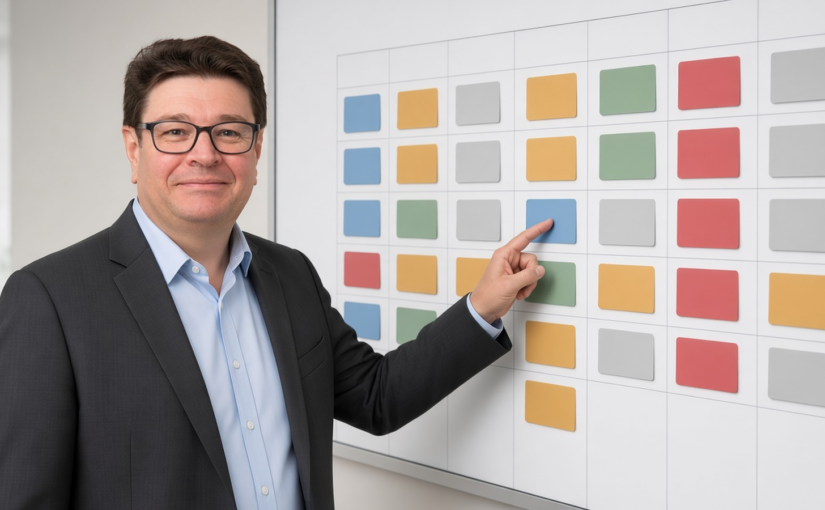
In the morning, participants introduced themselves in Mural, wrote their session ideas on cards, pitched them in turn, and built the session grid together.
The day was divided into five session slots, with a lunch break in between. Up to four parallel rooms were running. A coffee corner and a technical help room stayed open all day.
That morning I had said that a barcamp is a series of missed opportunities. That is why we met again at the end for a closing plenary: so that everyone could hear what had happened in the parallel rooms and later decide what they want to read.
Everything shown that day is licensed under CC BY 4.0. The videos are not online yet; I will provide summaries as soon as possible.
What the Sessions Brought Out
In the closing plenary the hosts reviewed their sessions in a few sentences.
In the first slot, Manuela Queisser summed up the Board of Excellence this way: a field report from the group brought the idea of an AI advisory board down to earth. It takes a great deal of time, but it is especially worthwhile for brainstorming.
The discussion hosted by Leonie Walter and Markus Walter was controversial. One position was that AI makes consulting obsolete. Others saw opportunities in experience, judgment, and guidance. One takeaway was that competence has to be recognizable to clients. That matters for positioning and trust.
Karl Kotté reported on experiences with a second brain. Only a few people in the group already had practice of their own. The exchange showed that alternatives require more computing power at home. He may report on the practice in 2027.
In the second slot, Manuela Queisser turned to AI in marketing. Ads inside AI tools are possible, but there is little experience and no data yet on who uses which tool and why.
Volker Pauling and Karl Kotté summed up their joint session “AI as a project management colleague” this way: it is becoming more important to provide the AI with the right context, that is, context engineering. Experiments need governance for data protection and company knowledge, owned by top management. Karl Kotté added, for his work environment, a sandbox without real customer data.
In the third slot, Michael Binzen hosted “AI, the last invention?”. The potential and the risks are enormous. Users nonetheless have little influence, because the race among U.S. corporations and between the United States and China has a momentum that is hard to slow.
Christian Schlaghuber described AI as curse and blessing at once. The group put its trust in real communities, in human strengths such as leadership and validation, and in personal responsibility rather than in politics.
In the fourth slot, Thomas Pargen showed that people can get smarter with AI if they use it as a coach and sparring partner. They understand more, make mistakes faster, and learn from them faster.
The session “Anthropic says no – now what?” focused mainly on local models.
In my session “12 colleagues. No humans,” the point was to treat AI agents like employees: with roles, structures, governance, and goals such as OKRs. That is because their knowledge is based on human texts.
In the fifth slot, Dirk Murschall explained AI agents from a user’s point of view, including the example of OpenClaw. At their core, agents are time-triggered prompts that they write for themselves. With a personality of their own via the system prompt, they become a sparring partner who also brings people back down to earth.
Michael Binzen presented Semantic Anchors, an open catalog of mental building blocks for prompts. The catalog has grown substantially, together with an appeal to contribute missing concepts. Its initiator had an AI build a convenient website where a short chat prompt suggests matching entries. The catalog is at Semantic Anchors.
Sandra Bartsch-Beuerlein spoke about implementing AI as a project. An AI phone assistant is not introduced in 30 seconds: as soon as several people use it, processes change. That takes project management and change management.
What Came Together in the Closing Plenary
The closing plenary began with a few minutes of quiet work in Mural. Everyone was asked to note what the day had brought, how satisfied they were with the barcamp, and whether they would take part again.
On whether they would recommend the day, all the dots were, in my reading, in the green range. I thanked everyone for the many positive comments and was glad that many want to be back next year.
The sticky notes I read aloud painted a consistent picture: food for thought, time well spent on exchange, a sense of where one stands compared with colleagues, and concrete next steps.
People also mentioned different ways of using AI, the courage to personalize their own digital team further, and new impulses, perspectives, and insights into other people’s work. Many new contacts were part of that as well.
Asked what should be different next time, several comments amounted to “like today” or “this works as it is.” One concrete wish was for practical sessions in which people try things out together. I offered to organize such sessions during the year as well.
Another point was more familiarity with Mural.
In the chat, many contributors thanked us for the barcamp, the facilitation, and a day of open exchange, ideas, impulses, and tips, including shared concerns as well as recommendations and book suggestions.
One voice described how the energy of the morning had flowed into the different sessions. Another wrote that the day made them want more. A third wants to pass the information on to interested people.
The recap of the implementation session led into a short discussion. One voice considered it obvious that processes change when a new tool is introduced.
Another voice described how, in large organizations, leaders are repeatedly surprised by the effort that human change management takes, meaning the question of how to bring people along. Because the effect cannot be measured directly, it is often treated as nothing more than a cost.
What I Take Away
In my own session I tried to pass on that agents need structure the way employees do: roles, goals, rules. Their knowledge comes from human texts. That is why they can work with forms that were designed for people.
Leadership therefore has a double task: to clarify responsibility for agents and to shape the changing collaboration among people. Technical possibilities alone do not answer these organizational questions.
Three recaps from different sessions fit this reading. In the joint session of Volker Pauling and Karl Kotté, the topics were governance and a sandbox without real customer data. Sandra Bartsch-Beuerlein showed that an introduction is more than an installation as soon as several people use a tool. Leonie and Markus Walter noted that competence has to be recognizable, especially when knowledge is easy to obtain.
The Next KI-Denkraum
The next KI-Denkraum will take place on Saturday, November 6, 2027, again online and free of charge. Registration for KI-Denkraum 2027 is already open. Anyone who registers early will receive a timely email and can block the date. A later cancellation is not a problem.
Anyone who liked the day is welcome to share the link. I do not pass on contact details.
I provide updates between barcamps through my newsletter. Anyone with an idea for a joint hands-on session can send it to me or post it in the contributors’ WhatsApp group. I then announce such sessions in the newsletter so that interested people can join. Current information is on the KI-Denkraum website.
A barcamp remains a series of missed opportunities. Videos will follow.
How can the value of change management be made visible when it cannot be measured directly?
Feel free to subscribe to my free newsletter. And follow along on Mastodon, Threads, Bluesky, LinkedIn, and Instagram.
Sources
- Marc Widmann: Ein Denkraum für Künstliche Intelligenz, May 22, 2026 – https://marc-widmann.de/ein-denkraum-fuer-kuenstliche-intelligenz
- KI-Denkraum website, retrieved November 10, 2026 – https://denkraum.marc-widmann.de
- Registration for KI-Denkraum 2027, Saturday, November 6, 2027 – https://www.tickettailor.com/events/marcwidmann/2494552
- Unpublished organizer plenary notes (opening and closing), November 7, 2026, not publicly available; the basis for this article
- Semantic Anchors catalog – https://llm-coding.github.io/Semantic-Anchors
- Ralf D. Müller: Semantische Anker: Warum „TDD London School“ besseren Code generiert als lange Erklärungen (in German), November 7, 2025 – https://rdmueller.github.io/pages/blog/semantic-anchors.html
- Wolf Hosbach: Semantische Anker verkürzen den Kontext für das agentische Coden. heise online, May 29, 2026 – https://www.heise.de/news/Semantische-Anker-verkuerzen-den-Kontext-fuer-das-agentische-Coden-11311061.html