
Summary
In early October, IPMA launched ICB5, the fifth generation of its competence baseline for project, program, and portfolio management. Artificial intelligence is one of five themes running through it. At the same time, generative AI can now produce a certification report that is hard to tell apart from one written by the candidate. My thesis is that AI changes how competence is evidenced, not what competence means. Certification will therefore have to move away from documents and toward conversation.
How Did This Post Come About?
A few days ago, I asked on LinkedIn: “Will we still need project managers who can build a project plan?” The discussion quickly went beyond planning.
Are written reports still meaningful evidence? Do we need more presentations and expert discussions? An oral exam as early as Level D? Maybe even question cards like in the old ICB3 procedure? And how much depends on commitment and maturity in the organizations where certified project managers end up working?
In one comment, I boiled my position down to one sentence: “AI changes the form of evidence, not the competence requirement.” But a comment is not enough for this question. So here is a fuller take. What is officially confirmed, and what do I conclude from it?
ICB5 Is Here. Just Not in the Exam Yet.
ICB4 was published in 2015 and has been the basis for certification in Germany since 2018. Its successor was approved by the IPMA Council of Delegates at the end of August 2026. It was presented at the IPMA World Congress in Hiroshima in September and officially launched in Zadar on October 2, 2026. Since October 16, digital copies have been available free of charge via my.ipma, in three volumes covering project, program, and portfolio management.
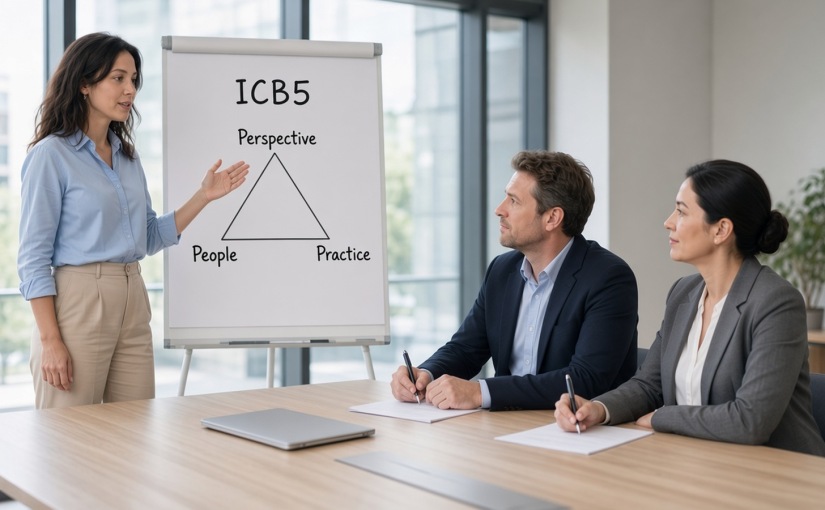
The “Eye of Competence” with Perspective, People, and Practice stays. New competence elements include Sustainable Stewardship, Digital Enablement, and Organizational Change and Transformation. All new IPMA standards share five themes. Sustainability, digitalization, agility, AI, and resilience.
On top of that comes the new Momentum Model, which traces the path from deliverables to outcomes, benefits, and long-term impact. So the bar moves from “project delivered” to “value created.”
What does this mean for anyone planning a certification right now? The ICB describes competences, not the assessment process. That is governed by IPMA’s International Certification Regulations (ICR) and the national certification bodies. In Germany, this is PM-ZERT, GPM’s certification body. Its current guidelines are still based on ICB 4.0. As I mentioned in my LinkedIn post, it can take several months up to a year before ICB5 is reflected in an exam regulation.
I see this transition period as an opportunity. When ICB5 is put into practice, we should rethink not only the content but also the forms of evidence.
How Is Competence Assessed Today?
Anyone debating AI in certification should know what the process actually looks like. At PM-ZERT, the current guidelines say the following.
| Level | Requirement (per guideline) | Forms of evidence |
|---|---|---|
| D | Purely a knowledge exam: the candidate’s own project management knowledge across all relevant competences; no project experience required | Path 1: report applying that knowledge to a real or fictitious project (max. 25 pages + 15 pages appendix), written exam (90 min), feedback talk on the report (max. 20 min) · Path 2: two written exams (90 min each) |
| C | Leading others in projects of moderate complexity | Report on 20 competence elements, written exam (120 min), assessment center with role play or case study (depending on the process variant), interview (60 min) including a 15-minute presentation |
| B | Leading others in complex projects, programs, or portfolios | Report, written exam (180 min), assessment center, interview (90 min) |
| A | Leadership of very complex initiatives at a strategic level | Conformity review (conversation, approx. 60 min), report (max. 25 pages + 15 pages appendix), workshop with assessment center (role play), interview (90 min) including a 15-minute presentation |
Two details are key for the AI question.
- At the end of the report, candidates declare that they wrote it on their own, without third-party input, “in particular not by means of AI software.”
- The same declaration states that the assessor must personally be convinced that the candidate wrote the work.
So the process already relies on conversation as a cross-check of the document. Which is good.
From Level C upward, this works. The assessment center, the presentation, and the interview show whether someone really understands their project.
Level D is different. It is purely a knowledge exam, and no project experience is required. And this is exactly where the cross-check is almost entirely missing. Path 1 includes a feedback talk of up to 20 minutes. Path 2 has no oral component at all. Whether candidates have actually mastered the knowledge themselves shows up almost only in the written exam.
Is a Ban Enough?
The AI clause is right and necessary. But it is hard to enforce if the document is all you look at. Two studies make this clear.
In 2024, researchers at the University of Reading submitted exam answers written entirely by GPT-4 into regular online exams of a psychology program. 94 percent went undetected. On average, the AI submissions even scored higher than those of real students.
In 2023, an international team led by Debora Weber-Wulff tested fourteen AI text detection tools, including Turnitin. Their conclusion is clear. The tools are neither accurate nor reliable, and none reached 80 percent accuracy. Even light paraphrasing made detection much worse.
Both studies come from higher education, not from PM certification. Does the lesson carry over? In my opinion, yes. A report that applies project management knowledge to a project situation in a structured way is exactly the kind of text language models handle well. That goes for the knowledge-based report at Level D as much as for the STAR descriptions from Level C upward. And the better the models get, the less detectors will help.
What Do We Actually Want to Prove?
Certainly not that someone can write a good text about a project. At Level D, we want to see that candidates have mastered project management knowledge themselves. From Level C upward, that they can lead a project responsibly. That means understanding how things connect, justifying decisions, dealing with resistance, and learning from mistakes. This is exactly what the ICB’s competence elements and key competence indicators describe.
AI does not change that. Quite the opposite. As AI agents increasingly prepare project plans, risk registers, and status reports, the judgment behind them becomes more important, not less. In my post on the Project Manager in 2036, I asked how we can teach the fundamentals of project management without undermining them through AI shortcuts. Certification faces the same question.
Universities are a step ahead here. Since 2025, the University of Sydney has been using a “two-lane” approach. Secure, supervised assessments show what students can do on their own. Open assessments explicitly allow AI, as long as its use is disclosed.
For PM certification, my position is clear.
- The report becomes the basis for a conversation. It still matters, but as preparation for the expert discussion and not as standalone proof. Whether AI helped with the wording matters less once the conversation shows whether someone truly understands what they wrote.
- An oral exam starting at Level D. At this level, it is not about project practice. It is about demonstrating that candidates have mastered the knowledge themselves, not just with AI support. A short, structured expert discussion, for example based on randomly drawn questions about methods and how they fit together, takes modest effort and has a big effect.
- Disclose AI use instead of just banning it. Candidates who work with AI explain what they used it for and how they checked the results. That is evidence of competence in itself and fits the new Digital Enablement element.
- Put more weight on live situations. Assessment centers and role plays show behavior under realistic conditions. AI cannot be used there unnoticed, not even today. Prepared materials and laptops are explicitly not allowed in the role play.
These are the four points I stand for. They are not announced changes to the exam regulations.
Commitment Starts in the Organization
Another point came up in the discussion that, in my opinion, is underrated. Even the best exam does little if the organization doesn’t tie the certificate to real responsibility.
A certificate confirms competence at a point in time. Whether it makes a difference day to day depends on clear roles, steering committees that actually decide, and a project culture that people live. I have already written about this in my posts on steering committees and on transformation and project culture.
IPMA sees the connection, too. Alongside ICB5, it released a new edition of the Organizational Competence Baseline (OCB2), whose five-level classification lets organizations assess their current level of competence. For me, both perspectives belong together. If AI makes project documents easier to produce, organizations need to be all the more explicit about who stands behind the content. As one participant in the GPM Focus Workshop in March put it: “Accountable is always the human.”
What Does This Mean for the Coming Years?
This is where it gets speculative. These are scenarios, not facts.
- Candidates are still assessed against ICB4 today. Reading ICB5 now still shows where the bar is heading. Toward impact, sustainability, and the responsible use of digital tools.
- For certification bodies and assessors, the move to ICB5 is the natural moment to review the forms of evidence. The more weight shifts to conversation and live situations, the more assessor qualification and calibration matter.
- Organizations are left with the question of how project accountability is anchored in their own organization. No certificate answers that. AI makes it more urgent.
I am firmly convinced that certification which tests competence in conversation will not be devalued by AI. It will become more credible. Certification that relies mainly on documents, on the other hand, will struggle.
Which leaves a question we should discuss openly as a community. Ten years from now, what kind of evidence will still prove that someone can really lead a project? And how much of it has to be delivered without AI?
What do you think?
Feel free to subscribe to my free newsletter.
Sources
- IPMA: Council of Delegates Communiqué, October 4, 2026 – https://ipma.world/news/ipma-cod-communique-3/
- PM-ZERT: General certification guideline (Leitfaden Allgemein), V18, August 1, 2026; guidelines for Levels D (V24), C (V16), B (V18), A (V18) – https://www.pm-zert.de/anmeldung/antragsunterlagen
- PM-ZERT: Standards – https://www.pm-zert.de/ueber-die-pm-zert/standards
- Scarfe et al. (2024): A real-world test of artificial intelligence infiltration of a university examinations system. PLOS ONE – https://doi.org/10.1371/journal.pone.0305354
- Weber-Wulff et al. (2023): Testing of detection tools for AI-generated text. International Journal for Educational Integrity – https://doi.org/10.1007/s40979-023-00146-z
- University of Sydney: AI assessment policy, November 27, 2024 – https://www.sydney.edu.au/news-opinion/news/2024/11/27/university-of-sydney-ai-assessment-policy.html