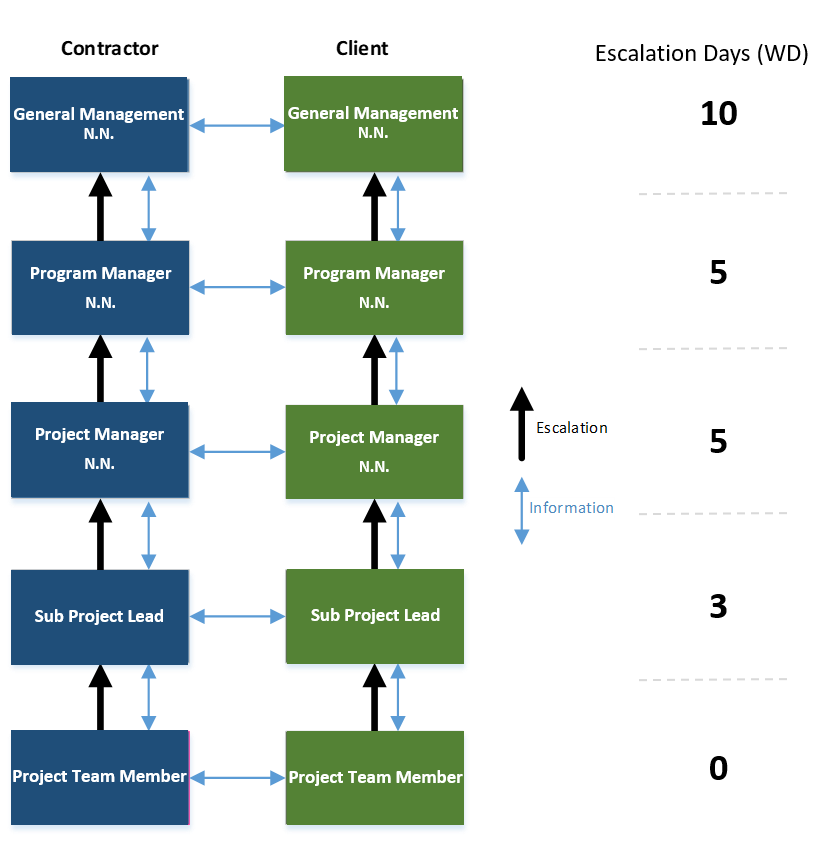
Escalations are nothing bad in the project or program. They are the demand for spontaneously necessary or not yet taken decisions in a defined way – provided that a regulated governance is established.
Rules
The facts of the case should always be described and agreed upon by both parties (customer and contractor).
Contents of the escalation
Precise description of the facts so that they can be understood directly by third parties.
In what area and at what time did the facts arise?
Who put the facts on the agenda in which reporting medium (e.g. weekly status report)?
What has been done to avoid the original risk or problem, to solve it when it occurs or to mitigate it?
Who was involved in the solution search?
Howtime-critical is the situation or by when is a solution needed?
Identification of the degree of risk and evaluation of the impact.
Which activities are proposed for the solution?
Description of the solution approach with estimation of the timeline, the resources and the name of the person responsible for the solution.
Communication
Escalation always via e-mail. Mails that do not contain all of the above should be returned.
Clear mention of the word “ESCALATION” in the subject line as well as in the mail itself.
All possible measures should be taken to resolve an escalation issue at the lowest level. Before starting an escalation process, the consequences should be clearly articulated.
At each stage, an attempt should be made between both parties to find a solution. If this is not possible, the escalation issue should be passed on to the next escalation stage after prior agreement and taking into account the number of escalation days. (Escalation days = length of stay in working days at an escalation level)
The project manager is responsible for solving the problem and remains so at every escalation stage.
Despite all standardization, special consideration – especially in international project portfolios – must be given to cultural differences among the project participants. The differences should at least be “intercepted”, if not used to advantage. The focus of a project portfolio manager’s work in an international project environment is shifting somewhat away from classic portfolio management tasks such as standardization towards cultural moderation and catalysis. Catalysis in the sense of cleansing intercultural differences and at the same time accelerating intercultural learning.
If there are problems with cooperation in international projects, these usually emerge more strongly than in national projects. Nevertheless, a well-managed international project is praised with more success than a purely national project. With the involvement of a “cultural agent”, these positive synergy effects can be leveraged.
However, not every problem of international projects has cultural origins.
But there are also intercultural problems that are not seen as such.
Cultural differences in international project portfolios
This article is an excerpt of my project study work 10 years ago in the context of the certification as Senior Project Manager (GPM).
Already in 2002, the GPM’s “International Project Work” Section conducted a survey of internationally experienced German project managers and identified the following important problem areas [Hoffmann, H.-E. et al., International Project Management, Munich 2004, pp. 13-14]:
Cultural differences
Communication / Language
Legal and political aspects
Technology / Infrastructure
Personal aspects
The greatest importance was attached to the cultural differences.
Differentiation of international differences
This paper does not deal with differences in laws, norms, guidelines or standards of the project business. Although these may also be influenced by the cultural conditions in different countries. Here only the differences or effects of culture on the project are to be considered. Culture is defined as “the change of nature through human actions and expressions and, based on this, the totality of life and work forms of a human group (people, class, religious community, etc.)”. [Wissen Media Verlag, https://www.wissen.de/lexikon/kultur-allgemein]
The concept of culture
Keller defines culture on the basis of various characteristics [Keller v., E.: Management in foreign cultures: goals, results and methodological problems of culture-comparative management research, Stuttgart, 1982, p. 114ff]:
Culture is man-made. It is a product of collective social action and individual thinking.
Culture is supraindividual and a social phenomenon that outlasts the individual.
Culture is learned and transmitted through symbols.
Culture controls behaviour through norms, rules and codes of conduct.
Culture strives for inner consistency and integration.
Culture is an instrument for adaptation to the environment.
Culture is adaptively adaptable in the long term.
Hofstede presents culture as a group-specific, collective phenomenon of shared values. [Hofstede, G./Bond, M. H.: The Confucius connection: from cultural roots to econonmic growth, in: Organizational Dynamics, Spring 1988, S. 21]
The cultural programming of a project employee / cultural layers
How does culture influence people, and why can Hofstede speak of a “collective programming of the mind”? A person is always born into a culture and absorbs it directly. Cultivation”, i.e. cultural programming, takes place as early as the baby age – at the age of 7, most of the culture is already internalized. [Dahl, Stephan (2000) “Introduction to Intercultural Communication”, from the book by Stephan Dahl: „Intercultural Skills for Business“, ECE, London, 2000]
People are suited to different cultural strata in different stages of life depending on their social environment: [Hoffmann, H.-E. et al., International Project Management, Munich 2004, p. 17]
The innermost and thus first layer originates from childhood and is characterized by
the country,
the social class,
the ethnic group,
the religious faith or also
the region
where they grow up.
The second layer is made up of vocational training. It often turns out that people from the same occupational group but with different cultural backgrounds understand each other better than people from the same country but from different occupational groups.
The third and last layer is made up of company-specific norms and behaviours. This is the so-called layer of corporate culture.
Since the majority of people often only move within one cultural group – and a confrontation with another culture takes place only superficially, if at all – “cultural programming” is rarely conscious either. International project management is a pioneer of change here. According to my own experience, only after typical project durations of more than 9 months do questions comparing cultures become more strongly discussed. After about 3 months in the course of the project, the respective advantages of the different cultures involved are adapted. After about 6 months, the first “frustrations” appear in the cultural field. After 9 months the cultural aspects are considered more strongly and also really considered. This means that for project durations of less than 9 months, a mature understanding of culture cannot be expected among those involved in the project. The project team member/leader continues to behave according to his cultural background and interprets all incidents according to his cultural programming. Thus, the behaviour of foreign project staff is often dismissed as “funny”, as it cannot be explained by their own cultural programming. An open discussion with another culture is therefore subliminally problematic because it can shake one’s own value system and challenge the questioning of basic values. It therefore seems at least understandable that many project participants avoid this confrontation to its full extent and withdraw into the familiarity of their own culture. This confrontation is unavoidable for project leaders who live in another country for a longer period of time. It takes about 12 months just to master the obvious rituals and behaviour under the assumption that the local language is spoken fluently. [Dahl, Stephan (2000) “Introduction to Intercultural Communication”, from the book by Stephan Dahl: “Intercultural Skills for Business”, ECE, London, 2000]
Another approach without exact origin provides for the following “culture shock phases”:
Phase 1 refers to euphoria, travel preparation, travel fever and curiosity about the other country. It usually doesn’t last long.
Phase 2 is the time of cultural shock when everyday life begins in the new environment.
Phase 3 is called acculturation, i.e. cultural adaptation, when one learns to live under new conditions, when one already knows some of the foreign values and integrates them into one’s own behaviour.
Phase 4 is then the mental stability finally gained, which can take on 3 different forms. Either
Strangers continue to feel strange
or in the new environment just as well as at home, so can live in both cultures
or more comfortable in a strange place.
The length of the phases is variable and depends on the duration of the stay in the foreign country.
Conversely, foreigners are also experienced by insiders (locals) in 4 phases:
Curiosity means positive interest in strangers.
Ethnocentrism means that insiders judge guests/newcomers/foreigners according to their own standards. One’s own little world is seen as the centre and pivot of the world. Ethnocentrism is related to a culture the same as egocentrism is related to the person.
Polycentrism means that different people have to be measured with different standards, as well as the ability to understand strangers on the background of their own norms. A moderate form of multiculturalism.
Xenophilia means that in a foreign culture everything is seen as better than at home.
The cultural programming of a culture
A culture is a group of people who all have the same or at least very similar cultural programming. This means that they almost all behave according to the norms and values of the culture, and measure the behavior of other people against these norms and values. Of course, this does not mean that all persons within a culture are totally identical – they behave only relatively similarly compared to behaviour in another culture, not necessarily compared to their own culture.
Models of cultural contexts
Various models have been developed in the search for explanatory patterns that help to understand the logical connections between norms and rules of a culture. “A model is a simplification of reality. A model can never be complete because it is always a simplification and cannot reflect all aspects of reality. For this reason, there are also different models for intercultural cooperation, each of which represents different aspects. For a project situation it is therefore helpful to be able to compare several models. [Hoffmann, H.-E. et al., International Project Management, Munich 2004, p. 32]
Cultural levels according to Edgar Schein
Schein distinguishes three cultural levels [Hoffmann, H.-E. et al., International Project Management, Munich 2004, p. 22]:
The first level contains the directly perceptible characteristics such as clothing, food, music or manners. Although these are visible, they require interpretation.
The second level consists of values and norms that provide guidelines for behaviour in a culture. These are also persons of the respective culture also only partly conscious. Cultural members often assume that these guidelines must also be identical in other cultures.
The third level contains beliefs that are so self-evident that they are ignored.
The cultural dimension “context reference” by Edward Hall
Hall compares cultures with regard to the strength of their contextual reference [Hoffmann, H.-E. et al., International Project Management, Munich 2004, p. 25]. Under context a situation or message can be understood anything that could be related to it (e.g. tone of voice and experienced or inexperienced colleague) [http://changingminds.org/explanations/culture/hall_culture.htm]. The degree of influence of the context on a situation is cultural and therefore interesting for Hall to define. A culture with a high contextual reference is a culture in which the context enjoys a high degree of attention [Hoffmann, H.-E. et al., Internationales Projektmanagement, München 2004, p. 25].
“Gifts are a sign of appreciation and are expected in cultures with a strong contextual reference to business initiation.” [Hoffmann, H.-E. et al., International Project Management, Munich 2004, p. 65]
Cultural dimensions according to Hofstede
In order to capture culture, a wide variety of approaches were shaped and studies carried out. One of the most important and yet trend-setting studies, which has come into its own in the meantime, records the following four most important dimensions (see table at the end of the article): Hofstede study. The higher the value, the more pronounced the index.): [Hofstede, G.: Intercultural co-operation in organisations, in: Management Decisions, 5-6/1982, p. 53ff; Index and classification: http://www.clearlycultural.com/geert-hofstede-cultural-dimensions/ ; Hoffmann, H.-E. et al., Internationales Projektmanagement, München 2004, p. 26ff]:
Power distance: The power distance expresses how high the acceptance is to accept power differences.
Individualism versus collectivism: Here it is described whether the individuals see themselves as individuals and independent or as members of a group/culture.
Masculinity versus Femininity: Masculinity in a culture is recognized as performance-related or success-related and self-confident. A feminine culture, on the other hand, pays great attention to interpersonal relationships and cooperation.
Uncertainty avoidance: Threat from uncertain or unknown situations and their avoidance.
The other dimensions are descriptive or approach supporting dimensions, which were added in 1987:
Time concepts: Here it is defined how strongly a culture is oriented towards the present, the past or the future.
Conceptions of space: Here it is recorded how socially distanced or introverted members of a culture behave.
Contextuality: There is a direct or indirect communication. This means how much context or non-verbal communication is anchored in the culture.
Cognitive processes: How are the thought patterns, the way of thinking, judging and conclusions pronounced in a community. E.g. Analytical, rational versus synthetic, intuitive.
Religious Concepts: Depending on their religious beliefs, the respective cultural members tend to regard their fate as self-controlled or under foreign control.
Effects of cultures on the project business: In the following, the first four cultural dimensions will be used to record the differences in the international project business.
Power distance
If employees from different cultures are deployed in a project and thus follow different power distances, different aspects have to be considered. My Indian colleagues have a higher power distance than my Scandinavian or German colleagues. This means that an Indian colleague expects more individual instructions and wants to make fewer decisions without consulting his project manager in order to be in his comfort zone. This should be applied up to operational guidelines with which a Mexican colleague as well as the Indian colleague feels “more comfortable” with very detailed guidelines, e.g. when preparing a status report. In comparison, induction training should be more detailed and systematic – based on the same project experience. An Indian colleague feels misplaced in a strongly cooperative project structure and expects clear structures and thus stability in his cultural structures.
Individualism versus collectivism
This dimension deals with the setting of priorities within society on the individual or on the group. In an individualistically pronounced society, the individual is at the forefront. In projects with employees from different cultures who represent different individualism indices (degrees of individuality), measures should be taken to support team building. Cultures such as the USA are considered very individualistic, which means that project staff from this country should be absorbed particularly intensively in the team spirit. Asian employees need intensive feedback continuously during the course of the project. They are dependent on feedback from many colleagues. They will actively demand feedback from all sides. It is advisable to include a feedback round in weekly or 2-weekly meetings / telephone calls that are already planned. North American projects required more portfolio-driven coordination rounds than, for example, Asian projects. The approach and coordination in Asian projects is more culturally rooted.
Masculinity versus Femininity
The Hofstede study found that the differences between women and men in this dimension were less pronounced. The cultural differences among men are more pronounced towards the poles versus . In my Scandinavian colleagues, the focus on interpersonal relationships and quality of life was very clear. Pressure to perform is not conducive in such environments, even rather harmful. The target values of a project are usually defined differently there than in comparison to projects initiated in German-speaking countries. This could be particularly clearly determined with the sensitive topic location dissolutions. Topics which were especially discussed differed between the sites in Sweden and Switzerland. In Switzerland, the focus was on the effectiveness of the closure (short project duration) compared to Sweden, where particular emphasis was placed on employee-oriented scheduling.
Uncertainty avoidance
Uncertainty avoidance can be defined as the degree to which the members of a culture feel threatened by uncertain or unknown situations. The differences can be seen in dealing with these threats. Societies with a strong tendency to avoid uncertainty seek to influence uncertainty through rules, laws, codes of conduct and security measures. Accordingly, particular emphasis should be placed on risk identification in countries with low uncertainty avoidance. In “emerging countries” such as Singapore, Hong Kong and Indonesia, the project environment should place emphasis on detailed risk identification. Project managers from these countries tend to overlook or ignore project risks. Project managers in countries with a high degree of uncertainty avoidance, such as Portugal, quickly identify risks on their own, but are more likely to have problems working out risk avoidance. This means that these project managers tend to bring the same risks to the table without taking the necessary measures. These are more “blocked” by the identified risks compared to other cultural circles.
Time concepts
Essentially, two concepts of time were identified in Hofstede’s study. The linear and the cyclical conception of time. In simple terms, cultures in industrial societies are more subject to a linear concept of time than cultures, e.g. in Asia. The linear approach represents the idea that what was in the past is over forever. In contrast, the cyclical time approach is based on the assumption that there is a constant change between day and night, moons, seasons and meal cycles. This approach is based on the assumption that a current performance weakness can be compensated in the future. These different approaches were actually identified in my portfolio. The degree to which objectives have been achieved and, above all, forecasts are strongly influenced by the cultural perception of time in the project manager’s home country. My Asian project managers are strongly guided by the approach that the current performance weakness of the project can be compensated in the near future. Generally speaking, project progress reports are more optimistic in cultures with a cyclical view of time than in cultures with a linear understanding of time such as the USA and Central Europe.
Another difference in the field of time perception can be observed in sequential or synchronous thinking. This means that in sequential thinking the idea prevails that things should be done one after the other. In contrast to the synchronous concept of time, which is based on the assumption that several things can be done simultaneously. In my portfolio, I was able to recognize this tendency not culturally, but person-specifically. This means that I could derive the differences in phase models, for example, less from their origin than from the personality of the project manager.
The German culture says: Everyone can use his time most efficiently if he has to wait for others as little as possible. The Spanish coinage leads: Everyone can make the most efficient use of their time when the issues at hand are closed in a meeting and no further discussion is necessary. In Spain, the one who breaks off a meeting to keep the next appointment is considered rude. [Hoffmann, H.-E. et al., International Project Management, Munich 2004, p. 20]
Contextuality
The distinction here is made whether in the cultural sphere much context prevails in the spoken (e.g. non-verbal communication; “reading between the lines”) or whether more direct, explicit communication prevails. My European project managers are much more direct / “blunt” in their communication than colleagues from Asia.
Cognitive Processes
Essentially, a distinction can be made here between western and eastern thinking styles. In the West the analytical style prevails and in the East (very pronounced in Asia) the synthetic style. In the West, the problem is broken down, in the East the problem is captured holistically and interlinkingly. Rational and systematic thinking style in the West in comparison to the intuitive and holistic thinking pattern in the East.
Cognitive orientation can also be found in the diversity of problem-solving styles. One of my Indian colleagues is strongly influenced by the “encircling thought”, which means that the problem is surrounded and encircled holistically. Progress is slower, but ultimately more complete and conclusive. In contrast, a German project manager breaks down the problem into its individual elements more strongly and solves subproblems for subproblems. Individual progress can be recognized more quickly, but may require subsequent holistic correction.
Religious concepts
Depending on religious beliefs, different cultures tend to see their fate as foreign or self-directed or controlled. I could not confirm the effects on religious beliefs in my portfolio, since cultural circles with a typically foreign-controlled background nevertheless produce project managers with a strong self-drive. It seems that changes have taken place since the study was conducted or that I have identified exceptional cases.
The cultural dimensions of Fons Trompenaars
Another cultural model was developed by Fins Tromenaars and Charles Hamptopn-Turner with the following seven dimensions: [Hoffmann, H.-E. et al., International Project Management, Munich 2004, p. 29ff]
Universalism / Particularism: In universal cultures (e.g. Anglo-Saxon and German-speaking countries, Holland and Scandinavia) all people are treated according to the same rules and laws. In particularist cultures, on the other hand, rules and laws are respected by one person, unless an important person would be disadvantaged. The same applies to concluded contracts: [ Hoffmann, H.-E. et al., International Project Management, Munich 2004, p. 67]. In particularist cultures, exceptions to contracts are made on a case-by-case basis. Universalistic cultures do not allow this.
Individualism and collectivism: Identical with Dimension von Hofstede.
Emphasis on emotions: This is a comparative measurement of how feelings such as joy, sadness or commitment are shown. Project team members from the Middle East raise their voices to emphasize your emphasis. Asian project workers are associated with a loud voice, anger and lack of control.
Specific / diffuse cultures: Specific cultures (e.g. Anglo-Saxon countries, Scandinavia and Holland) clearly define roles and assign concrete situations or localities to them. In such cultures, the role of the superior is not necessarily transferred to another (e.g. private) environment. In diffuse cultures (e.g. Arab countries and Africa), assuming a role means that it also applies to a change of environment.
Performance versus origin: In performance-oriented cultures (e.g. Anglo-Saxon and Scandinavian countries), superiors are respected who perform their tasks competently and demonstrate adequate professional competence. In cultures based on origin (e.g. China and Malaysia), on the other hand, the project manager receives his status through his title, age or family affiliation.
The relationship to time: In polychronic cultures (e.g. Latin America, Africa, the Middle East, France), time is an unlimited, simultaneous commodity that can stretch. One plans, but can easily adapt the plans. Several things are done simultaneously. For this reason, one can observe a French project team member approaching a meeting and important telephone calls in parallel. In monchronic cultures (Saxon, northern and central European countries), on the other hand, time is considered a limited commodity that must be carefully planned and adhered to. Work is more sequential, i.e. linear.
Relationship to nature: Indoor controlled cultures (e.g. Anglo-Saxon countries, Northern Europe) want to keep their environment and environment under control. This is closely linked to the belief that one can influence one’s destiny through action. Externally controlled cultures (e.g. Arab, African and Asian countries) shape people in such a way that they see themselves as part of nature and should therefore adapt it to their environment.
Nonverbal Communication
Non-verbal communication and body language is not a direct cultural dimension, but a collection of behaviours. A direct connection with a cultural dimension as described above does not seem to exist, at least not directly. Basically one can assume, however, that in Asia in particular body language is rather subdued, whereas in Southern Europe body language is used more. It is therefore advisable to familiarise oneself with the most common symbols before interaction.
Avoidance of intercultural misunderstandings
Intercultural competence is defined as the ability to move successfully in cultural areas other than one’s own. The acting persons should be able to understand the ideas, motives and problems of interlocutors from other cultural areas and to react appropriately. However, since there are still no clear findings in science about the key factors for human adaptation to foreign cultures, there is also no clear understanding of what intercultural competence ultimately consists of.
If a project manager or project member perceives a violation of rules by a person of another culture, his conclusion should not be “he violates the rules”, but “he violates our rules”. [Hoffmann, H.-E. et al., International Project Management, Munich 2004, pp. 18-19]
“So it’s important to understand the behavior of others in the rules of your culture.” [Hoffmann, H.-E. et al., International Project Management, Munich 2004, p. 19]
Cultural misunderstandings can also be reduced by applying universal communication rules:
Meta-communication: Meta-communication is communication via communication. It is about communicating the meaning and intention of what is said by talking about the rules and patterns according to which communication takes place.
“My intention is to … experience …”
“How would you proceed in your culture if you had that intention?”
Active listening: Active listening means picking up the others in their emotional world. Active listening includes the following techniques:
Repeating the heard facts – the listener reproduces what the speaker says in his own words. “You mean that…”
Speaking to feelings – The listener tries to express in words what feelings and sensations he has perceived in the speaker.
“I have the impression you enjoy it.”
Inquiry – Inquiry offers the opportunity to present the problem situation even more clearly and to understand it better. “What do you mean by…?
Promoting qualities for learning intercultural competence:
Ambiguity tolerance the ability to cope with unstructured and contradictory situations
problem-solving skills
Empathic ability to read out the empathy, concerns and interests of others from vague hints, gestures or other signals.
Tolerance of frustration to deal adequately with errors, misunderstandings and failures.
Conflict ability and conflict tolerance
Readiness to learn with curiosity
Strong individual-cultural identity awareness of one’s own cultural imprint as a prerequisite for dealing with people from other countries/cultures
Distances ability to view oneself from a certain distance
Humor, the ability to laugh at oneself.
Prejudices and stereotypes
“A collection of information on what behaviours and norms typically prevail in a culture is called a stereotype. [Hoffmann, H.-E. et al., International Project Management, Munich 2004, p. 19] Stereotypes help people to interpret the behaviour of people from another culture.
This in turn allows the classification of further information.
The prejudice arises when the embossed stereotype is no longer changed by new information.
Nobody meets the standards in all points, some even deviate strongly from each other [Hoffmann, H.-E. et al., International Project Management, Munich 2004, p. 21]:
Population distribution and stereotypes
Moreover, some countries are in such a state of flux that there are clear cultural differences between parts of the younger and older generations, such as the former communist states. [Hoffmann, H.-E. et al., International Project Management, Munich 2004, p. 33]
Country
Power Distance
Individualism
Masculinity
Uncertainty avoidance
Malaysia
104
26
50
36
Guatemala
95
6
37
101
Panama
95
11
44
86
Philippines
94
32
64
44
Mexico
81
30
69
82
Venezuela
81
12
73
76
China
80
20
66
40
Egypt
80
38
52
68
Iraq
80
38
52
68
Kuwait
80
38
52
68
Lebanon
80
38
52
68
Libya
80
38
52
68
Saudi Arabia
80
38
52
68
United Arab Emirates
80
38
52
68
Ecuador
78
8
63
67
Indonesia
78
14
46
48
Ghana
77
20
46
54
India
77
48
56
40
Nigeria
77
20
46
54
Sierra Leone
77
20
46
54
Singapore
74
20
48
8
Brazil
69
38
49
76
France
68
71
43
86
Hong Kong
68
25
57
29
Poland
68
60
64
93
Colombia
67
13
64
80
El Salvador
66
19
40
94
Turkey
66
37
45
85
Belgium
65
75
54
94
Ethiopia
64
27
41
52
Kenya
64
27
41
52
Peru
64
16
42
87
Tanzania
64
27
41
52
Thailand
64
20
34
64
Zambia
64
27
41
52
Chile
63
23
28
86
Portugal
63
27
31
104
Uruguay
61
36
38
100
Greece
60
35
57
112
South Korea
60
18
39
85
Iran
58
41
43
59
Taiwan
58
17
45
69
Czech Republic
57
58
57
74
Spain
57
51
42
86
Pakistan
55
14
50
70
Japan
54
46
95
92
Italy
50
76
70
75
Argentina
49
46
56
86
South Africa
49
65
63
49
Hungary
46
55
88
82
Jamaica
45
39
68
13
United States
40
91
62
46
Netherlands
38
80
14
53
Australia
36
90
61
51
Costa Rica
35
15
21
86
Germany
35
67
66
65
United Kingdom
35
89
66
35
Switzerland
34
68
70
58
Finland
33
63
26
59
Norway
31
69
8
50
Sweden
31
71
5
29
Ireland
28
70
68
35
New Zealand
22
79
58
49
Denmark
18
74
16
23
Israel
13
54
47
81
Austria
11
55
79
70
The higher the value, the more pronounced the index.
The first hours or at least days within a project do shape most of the ongoing communication in a project or program. In other words: if you do not or too late define communication principles in a project you will need to cope with issues in a later stage.
All soft topics like usage of mobile phones or laptops during meetings, respect between each other, listening to colleagues, confirm understanding, participation by all in meetings, avoid mails but call instead, and so on and so forth are topics which are often more easy to follow than the individual behavior in following topics. Therefore guidance should be given.
A set of my standard communication set up in projects from day 1 onwards as an example below.
Useful communication principles
I would like to ask you to follow these communication principles:
To minimize our mail traffic and an easier organization of our mailboxes we should agree on the following rules:
Only send mails towards the team members who need the information!
Sounds funny, meant is: avoid big distribution list without need! (same with copy!)
As long as we are working on drafts or on finalization of templates the drafts are only send around the nominated team
Often big copy distribution lists in mails are used for escalation just to be sure in case this could be needed: Please contact and inform the Program Manager respectively the needed team member before. The Stream Leads are asked to design a workaround for internal escalation handling in their streams.
We agree that the work of all of us is very important for this program! For that reason only mails with a critical timeline are marked as urgent.
Mails with a critical impact for the program content have to be marked with URG at the beginning of the subject.
To avoid overload the capacity of our mail server we send links where ever it is possible
Last but not least: Don’t bury the needed information’s in mail chains …
Mail naming convention
All Mails have to be marked with the kind of information is given with the e-mail
INF: Information; an information is given to the addressees, no action required
ACT: Date, Action; and action is required by the addressee
DEL: Delivery; a required action is delivered
URG: urgent information’s start with this prefix e. g. URG: DREAM: SP01: … – see also file naming convention
Mail subjects needs to include a short and clear description of the content
Addressees on copy have in general no action !
Escalations In general the escalations come up as followed:
Team Members to Subproject Managers
Subproject Managers to Project Management
Project Management to Program Sponsor / SteercoE.G.: INF: DREAM: SP01: Mail Convention
Document naming convention
All documents in the program are named as followed:
Date (yyyymmdd)
Project Name (DREAM) and sub project number (e. g. SP01)
Document name
Version (drafts V 0.1 ff; finalized versions V 1.0 ff)
Why does the topic of committees move us as project managers? We need clear decisions for our projects in cases where our empowerment is not sufficient. Why is it often difficult to obtain these necessary decisions promptly, clearly and precisely?
For this we have to understand that there are countless terms for one and the same … and many terms are used several times in practice.
I will come to the typical problems with the committees that result from this later.
Where can we find a solution? PMI braces role descriptions and organizational structure. So we cannot be helped here. Prince2 defines the mentioned committees in detail and harmoniously with IPMA or GPM.
DIN 69901-5 defines the project board as a “superordinate body to which the project manager reports and which is available to him as a decision-making and escalation body”. This does not really help much.
Then let’s see how the PM3 of the GPM supports us.
What are steering committees? They can align the ship’s rudder in all directions on all seas.
These steering committees are … internal and … cross-project. Patzak/Rattay defines steering committee, steering group and project advisory boards as synonyms. The task of this committee is to analyse, observe and control the selection of projects and the interrelationships between projects.
The project board is also very well defined in the Duden … in my opinion ….. Namely as the “Committee for Economic Steering”. In contrast to the steering committee, this is not about defining the general meaning of a project, but about economic observation and influence. The project board is therefore represented at the steering wheel in the car on specified roads and can decide which direction to take at which intersections.
This committee, the steering committee, can also include external partners such as important suppliers or the end customer.
The PM3 states that there are no uniform rules in the organizations how control boards should work. It therefore differs from company to company. However, a typical responsibility can be worked out. The steering committee
appoints the Project Manager
selects projects
stops projects
initiates projects and shapes the
sets high level targets.
The PM3 also describes typical areas of responsibility for the project board. These are
project progress tracking
to clarify conflicts and powers between line and projects
accept milestones and project results
escalation in corporate management or portfolio management and
possibly, if there is no separate change board, the decision of amendments.
What do we as project and program managers have to do to be successfully supported by committees? Based on my experience I will explain the most important points.
we need to shape these bodies by
integrate necessary external partners
attract members to the committees who are highly placed in the hierarchy
demand that a spokesperson for the panel be appointed
escalation instances and solution durations at the respective escalation stages and also to
agree change management process.
What prerequisites and knowledge are required in the steering committees? According to Patzak / Rattay, they must have transparency and knowledge about the corporate strategy and knowledge about the project portfolio. Otherwise, the steering committee or portfolio board cannot act sensibly.
In order to be able to use the committees properly, we must observe a few basic rules.
Children and managers have at least one thing in common. They can only remember 3 things.
In your remarks as project manager in the project board, I therefore recommend that you address
the most important status information
a decision request and
a wish to cooperate
to the management.
Always pay attention to formulate these core messages concisely and precisely, because since the year 2000 until today, the attention span with us humans has fallen from 12 to 8 seconds. Thanks to the new technology and the new lifestyle.
Now I come to the typical problems that have already been announced. Experiences from my projects.
Berlin. Public project. In public projects, it is often very difficult to separate the project client and the shareholders. Especially the governance organization becomes complex. Defining the requirements in such a construct is particularly difficult, as is managing changes. A “reinstatement” – this verb sounds already governmental or public – is preprogrammed here.
South Africa. A project at an energy company with several divisions, which is to standardize central processes and IT systems. Due to the sheer size of the project, several external parties are required. In large-scale projects, the project offices are often staffed by external consulting companies to underline the challenging and neutral character.
Even as the largest contractor, it can be difficult to formulate uniform committee definitions and appointments. Agreeing on maximum solution times for escalated problems at the respective escalation levels is often an impossibility, but critical to success.
Israel. Again an energy company with several subsidiaries to harmonize their procurement organizations and processes. A further problem with the committee use is the decision fixation and above all the enforcement of decisions. In the run-up to committee meetings, pre-socialised decision alternatives and decisions are often questioned or not enforced again after the meeting has taken place. Here the cultural influence is formative and steering out. Decision making can take many times longer.
Bonn. Escalation levels are not mirrored for the client and contractor, i.e. there is a different number of hierarchy levels. Problems are inevitable. A further problem unfortunately arises from frequent statements and implementation of “an internal project must also function without LA”. How is that supposed to work?
I would like to conclude with the typical problems here.
What 3 core messages should you take with you today?
We must understand the differences between the Project Board and the Steering Committee and always recognize the two types of bodies, and
Working Out Loud is particularly suitable for working in projects. It is not a classical method, but claims to be an attitude to life – with associated practical techniques. The elements are: Making work visible and improving it, making contributions, building social networks and working together purposefully.
Introduction to WOL
Working Out Loud is an approach from the USA, which is particularly suitable for employees in projects. The initial father of the idea was Bryce Williams. John Stepper skillfully generated a movement out of it. It is currently sloshing across the ocean and gaining new users in Germany. This attitude to life also leads to lived values which are not everyday in this combination. Austin Kleon also presents similar approaches in Show Your Work.
The five core elements of Working Out Loud are (as originally listed on workingoutloud.de):
Make work visible – publish intermediate results,
improve work – cross-connections and feedback help to continuously
improve your results, make generous contributions – offer help instead of self-portrayal,
build social networks – this is how broad interdisciplinary relationships emerge that advance,
work together purposefully – to exploit the full potential of the community.
The application in a company like T-Systems with parallel application of classical project management is presented.
Content are practical examples of the application, the success criteria of the approach and its hurdles in a project organization before.
Working Out Loud in a project management organization
How does an application work in a group like T-Systems using classic project management approaches? Isn’t that contradictory? Employees at ThyssenKrupp, Robert Bosch and T-Systems practice these attitudes and techniques.
„Working Out Loud“ means „publishing“ one’s own work, reporting progress, problems and mistakes and exchanging information with other colleagues so that everyone can benefit from what has been learned. So nothing new you think spontaneously?! A combined application of the core elements of the Working Out Loud approach requires discipline, openness and consistency.
How does this happen in practice in the project?
The exchange in „one’s own juice“, i.e. in one’s own project, is not enough. A first basic requirement is to approach central departments such as those responsible for tools or processes, or in the best case also other projects. Even with positions that are often not very popular, such as central quality management units, project management handbook managers or tool owners, is necessary. An intensive exchange about objectives, application and solution of the upcoming challenge is a must. I have lived this consistently for my current project in which we had to develop a degree of progress and forecast process and tool that did not correspond to the company standard due to special circumstances. Even the sharing of micro results with project colleagues who are not (directly) affected raises undreamt-of potentials. The integration of stakeholders such as clients, users and policymakers is common practice, but only partially increases the potential. Networking also outside the Group for the exchange of ideas is essential. Otherwise, the efficiency and effectiveness of every project will suffer. The process, the specification, the tool, the training and the rollout took an unprecedented three weeks. Just two months after the introduction, what had been created was then presented to the annual group-wide worldwide project manager community and defined as good practice in the sense of „making contributions to the community“. A degree never achieved before in this time span. Strictly speaking, it is not only the speed that is unusual, but also the „overall“ (apart from standard processes and tools). Working Out Loud opens new horizons and brings a fresh vitality and interactivity into and around the projects.
Even in large corporations, this „combined approach“ Working Out Loud is applicable from already known approaches and bears fruit beyond the individual project.
The author presents further practical examples of the application, the success criteria of the Working Out Loud approach and also its hurdles in a project management organization.
Active participation in „WOL with Group Security and NDA“ working group
If you would like to actively participate in a working group on „Working Out Loud with Corporate Security and NDAs“, please contact me.
Presentation
In the spirit of the WOL I have released the presentation of the PM-Forum Version 3.0 again for commenting. Thank you very much for all previous hints about Version 1.0 and 2.0!